advertisements
  • Ferrari driver arrested for speeding through a YouTube footage


    A Japanese doctor has been arrested through a video he uploaded on YouTube showing off how he speed a Ferrari 458 Italia on some public roads in Japan. The 50-year-old doctor shot the video somewhere in April 2011 and allegedly posted the footage on YouTube. As a result, a group of angry internet users complained to the authorities. The authorities in Japan traced him down with several roadside speed cameras as well as the video on YouTube – several from outside, and one from inside.

    The $230,000 exotic features a 4.5L V8 engine pumping a nearly 570hp and is able to take off from zero to 100 km/h in just 3.4 seconds. The driver is facing charges of speeding as he is driving 77mph (124km/h) in a zone marked for 25mph (40km/h) which is three times more than the speed allowed. The driver is still considered breaking the rules although it is a very slow speed for a monster that can go up to 202mph (325km/h). The law in Japan is strict against speeding, unlike what is shown in the 2006 movie “The Fast and the Furious: Tokyo Drift” where it shows anyone can drive in high-speed as long as the police car is not able to catch up with the speed.

    The doctor, who is from Okawa in Fukuoka Prefecture, could face a $1,220 fine or up to six months in jail if he is convicted. $1,220 may cost nothing to him compared to the expensive exotic car he owns but it will be a great lesson for him.

    “I wanted people to understand the beauty of a Ferrari.”, said the driver. However, the doctor’s Ferrari was being smoked by a white Porsche all the time in the six-minute video and this may be one reason that other Italia owners feel unhappy with his driving skills and have it reported to the police.

  • Honda Insight: One of the cheapest cars to own

    2012 Honda Insight
    There are reasons why the Honda Insight is getting more and more on the road and the sales keeps on increasing. Is it because it is cheap to buy, cheap to maintain, and gives really good fuel mileage? Let us share our reviews on the all-new 2012 Honda Insight and see if these are true. Thanks to Jeremy who had invited us to test drive his 2012 Honda Insight which he has just driven the car out of the show room last month. It is a one-month old baby and everything is brand new when we check out the car. We can still taste the new car smell in when driving it.

    Jeremy paid RM99,800 to drive the car out of the Honda Showroom. These include the car price of RM96,686.65, insurance for a year RM2743.35, road tax for a year RM70 due to its engine capacity, and a few hundred dollars for handling fee, endorsement fee, and registration fee.

    The Insight features a 1.3L i-VTEC four-cylinder IMA (Integrated Motor Assist) engine that produces 88 hp and 121 Nm. The motor itself produces 14 PS and 78 Nm which is a significant improvement compared to the previous models. The maximum combined output is 98 hp and 123 Nm of torque. The hybrid system also consists of a nickel-metal hydride battery pack which is stored in the cargo floor below the spare tire. The power is transferred from the engine to the front wheels through the famous CVT (Continuously Variable Transmission) system.

    Design of The Car

    Honda Insight

    It is charming, silky, and the aerodynamics of the car is great. Together with a set of 16” alloy rims and 185/55R16 tires, we can also see some image from the first generation Insight that was introduced in 1999. The 2012 model features a new pair of headlights that wear a blue tint highlight. The rear lights have been modified for better visibility.

    The overall height of the car is 4,395mm but when one of our crew members with the height of 175cm sat on the driver’s seat, he can feel his head hitting the roof. Taller drivers may need to modify the height of the seat for more comfortable drive. The rear seats are a little bit cramped too. The boot is quite big and large items can be pushed into the car with the rear seats fold down. The space of the boot is one reason that makes Jeremy decide to take this car rather than the Prius.

    Honda Insight rear view

    Road Test

    We didn’t really rev the car very fast because it is still a new-born baby to the owner. Jeremy allowed us to drive his car up till 120 km/h (75 mph) and try the performance of the car from 0 to 100 km/h. We drove the car for a few kilometers and it gave us the feeling that says, “Just go as far as you want, the fuel will take care of itself”. The cabin is quiet during the ride but there are not enough leg rooms for rear seats. It took us about 11 seconds to accelerate from zero to 100 km/h, a few seconds faster than the Honda Civic but a split of a second slower than what it is written in the brochure. It could be due to the gas pedal not fully stepped.

    At the right hand side of the steering wheel, there is a cruise control button where driver can set and maintain a steady speed for long journey drives. This will give better mileage. Besides, there are also a lot of gadgets to play around. These gadgets are mostly related to the hybrid system.

    Honda Insight interior

    Fuel Economy

    41 city/44 highway mpg; 17.4 city/18.7 highway km/l; It is impressive but it does not measure up to the Toyota Prius which rated at 53 city/46 highway mpg.

    What is good about this car?

    The Honda Insight is without a doubt a great 4-door hatchback and also one of the cheapest cars to own this year. According to Yahoo, the average 5-year fuel cost is $6,508, the average 5-year insurance cost is $5,487, resulting in the total 5-year ownership cost of $29,786 in the U.S. It has been proven that the Insight is cheap to buy, cheap to maintain because spare parts are inexpensive, and most important it is enjoyable to drive. This also explains why the 2000 Honda Insight has been ranked as the most efficient Environment Protection Agency (EPA) certified gasoline-fueled vehicle ever. Besides fuel economy, the 2012 Honda Insight scores an overall of Good results from the IIHS crash test.

    Honda Insight

    What is not so good about the car?

    The only concern about buying a hybrid is the replacement of the battery pack that could be costly. The car battery enjoys a warranty of up to 253,000 km (157,000 miles) of use or 10 years. The battery pack will cost around US$2000 dollars and an extra of US$900 dollars for the installation. During our test drive, we notice that the car engine shuts off with auto-off engine at traffic lights and the air-conditioning is off too.

    Honda Insight interior

    Price

    • United States: MSRP from $18,350
    • United Kingdom: Price from £16,995 OTR (On The Road)
    • Malaysia: As of 2012, only one model available at RM99,800 OTR.

    Honda Insight’s main competitor: Toyota Prius is, and always is, the first challenger for the Insight. Although the Insight has undergone great improvements, it still has a long way to go to catch up with the Prius as far as the headroom, legroom, and fuel mileage are concerned. The Insight’s mileage is not as good as that of Prius but it is still one of the most popular hybrid cars with cheap selling price. Other than that, the 16.1 overall steering ratio, 5.17m turning radius at wheel, and 11m turning radius at body make it more fun to drive compared to the Prius.

    Honda Insight’s similar cars: Lexus CT 200h Hybrid, Volkswagen Touareg Hybrid, Honda CR-Z, Honda Jazz/Honda Fit, Toyota Prius C, and Ford Fusion Hybrid.

    In conclusion, the Honda Insight has proven that hybrids will not make a dent in your pocket. It is a hybrid car that can hug the road and the planet at the same time.

    Honda Insight

  • How To Drive An Automatic Car (Video)

    [cvg-video videoId=’4′ width=’500′ height=’333′ mode=’playlist’ /]

    This is a short video to show you how to drive an automatic car in few easy steps. It was taken in HD mode and it can be enlarged. Follow these steps and you can learn to drive a car easily.

    Step 1: Make sure the handbrake or e-brake is engaged and the gear knob is positioned at P (Parking).

    Step 2: Step on the brake pedal with your right foot and turn on the ignition to start the car.

    Step 3: Shift the gear selector to D (Drive) mode and release the handbrak/e-brake.

    Step 4: Shift your right foot to the accelerator or gas pedal and step on it slowly. The more gas you put in, the faster the car will go.

    Click here “Learning To Drive An Automatic Car” for more details with images.

  • Learning to drive a manual car

    Most people find learning to drive a manual car is much harder than an automatic car especially when they need to do a parallel park or drive uphill. Students often fail in these two skills in the driving test. There is a necessity to master these skills not only for the test but also to drive better in your life. Here is the step by step on how to drive a manual car and tips to handle all kind of circumstances in a manual car.

    Understand a manual transmission car

    Manual car

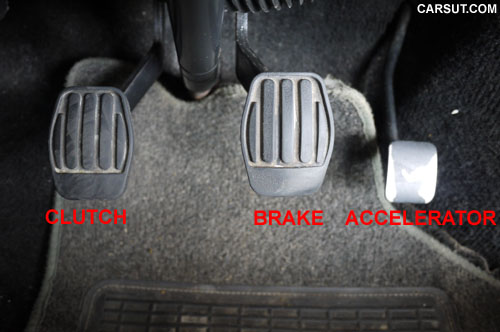
    A manual transmission car has three pedals: on the right is the gas pedal/accelerator, on the left is the clutch pedal, and in the middle is the brake pedal. A clutch is a doorway to shift the gear. No gear can be shifted if the clutch is not applied. Whether it is LHD (Left-Hand-Drive) or RHD (Right-Hand-Drive), you will see these three pedals. For LHD car, you will use your right hand to shift the gear and the other way round for RHD car.

    Study the Stick Shift

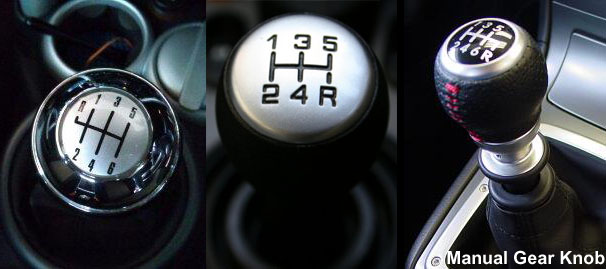
    Stick Shift

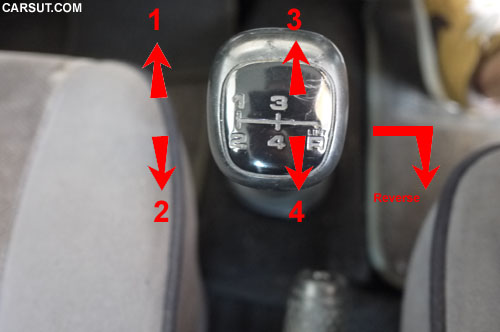
    Most of the manual cars running on the road today are five-speed. Some manual cars like the Honda CR-Z have six-speed while some earlier type has only four-speed. Before driving the car, sit on the driver’s seat, use your left foot to press the clutch to the floor and try to shift every gear to familiarise with it. The numbers indicate the gear and the “R” means reverse gear. Check if your gear knob has a button that locks the reverse gear. Some cars like the Renault Kangoo comes with a lock where you need to press/pull a button to shift the gear into reverse. Once you are familiar with the shifting, make sure you shift it back to neutral (in the middle where you don’t feel the stiffness in the gear stick) before starting the car.

    stick shift pattern

    Step by step to drive a manual car

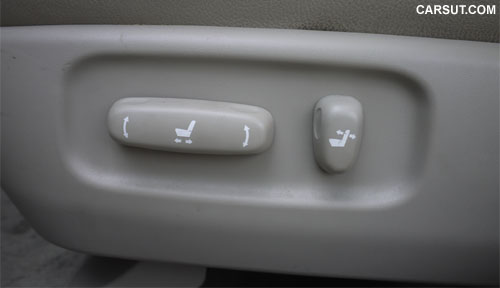
    Step 1: Adjust the driver’s seat to a position where you can fully step down the clutch pedal with your left foot. Your body will move back a little bit when you drive up hill. Therefore, do not slight the seat too far or too close from the pedals.

    automatic seat adjuster

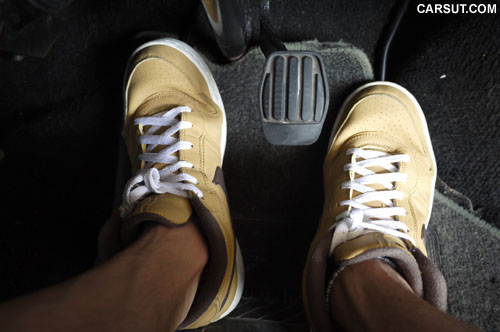
    Step 2: Make sure the gear is shifted to neutral and the handbrake (e-brake) is engaged. Use your right foot to step on the brake and start the car. For better practice, you may also press the clutch with your left foot every time you start the car to avoid the car going forward if the gear is engaged without your knowing.

    manual transmission car

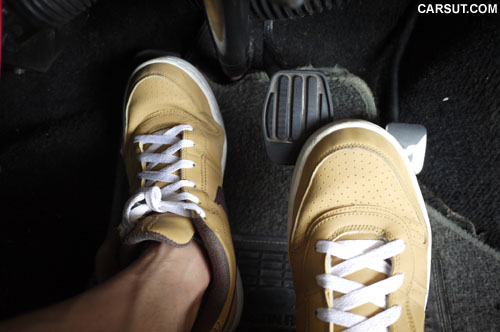
    Step 3: Press the clutch all the way down to the floor and shift the gear to first (1) gear. Look around to see if there are any vehicles coming. If it is safe to take off, release the handbrake.

    Step on the clutch

    Step 4: Release the clutch gently and step on the gas pedal lightly simultaneously. Give more gas to the car or hold the clutch if the engine sounds like it is going to stall. Move your left foot to the foot rest area when the car moves forward.

    drive a manual car step four

    drive manual transmission car step 5
    Step more on the gas pedal/accelerator to go faster

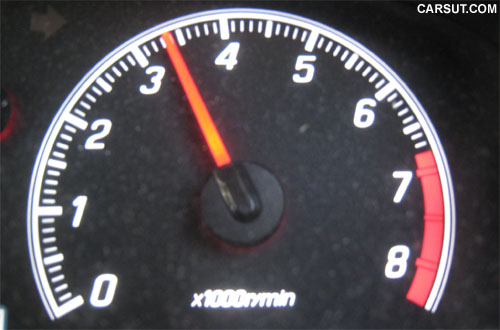
    Step 5: Change gear. An experienced driver knows when to change the gear by listening to the engine sound. A good way for beginners is to look at the RPM gauge. Shift the gear when it reaches about 3000 to 4000 rpm. To shift to second gear, lift the right foot from the gas pedal, press the clutch pedal all the way down and shift to second gear. Release the clutch gently and step on the gas pedal as in Step 4. The more you step on the gas pedal, the faster the car goes. Repeat the same process to shift to other gears.

    3000 rpm

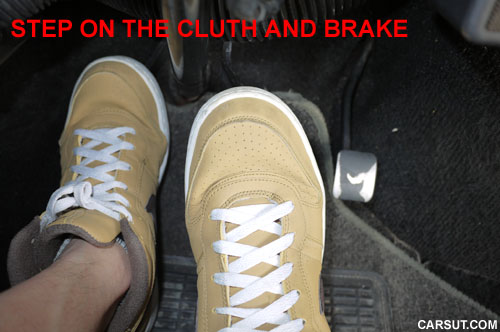
    Step 6: Slow down and stop. Lift your right foot from the gas pedal, use the left foot to press the clutch, and then apply the brake to slow down the car or to stop the car. Once the car is stop, shift the gear to N (Neutral) and apply the handbrake.

    drive manual transmission car step 6

    Tips

    Seating Position. Many people fail in the driving test during uphill because their left foot could not fully reach the clutch pedal. This is because the seat is too far from the pedals. Adjust it to a position where you are able to press the clutch all the way down the floor even your body is close to the seat.

    Clutch Control: First gear is always the hardest. Control the clutch gently every time you release it. Gently here means slowly, gradually, or bit by bit. Many first time learners lift their left foot immediately and cause the car engine to stall. Step hard on the brake and the clutch, and pull the handbrake to stop the car in case of emergency.

    Reverse: Many people make mistakes by shifting the gear to reverse while the car is still moving forward. Wait until the car stopped completely and then only shift to reverse gear.

    Stop at traffic: Shift the gear to neutral and apply the handbrake every time you stop at traffic. This is to secure the car from being jerk forward if you are hit from behind.

    Going uphill: If you are going uphill and need to stop the car on the slope, shift to neutral and apply the handbrake. To continue the journey, step on the clutch, shift to first gear, and give more gas (step harder on the accelerator) with your right foot. Release the handbrake when you feel it is powerful enough to move forward. More gas (But not too much) is needed because the car is in a sloping position.

    Going downhill: Shift to lower gear for downhill driving to increase the engine braking effect.

    Most drivers experienced engine stall while they learn how to drive a manual car. Practice makes perfect. The more you practise, the better your driving skill will be.

  • How To Parallel Park A Car

    Parallel parking is always a coup de grace for drivers who are taking their test. It is not hard at all to parallel park a car as long as you have caught the skills during the training. For beginners who have just started to learn parallel parking, it is recommended to learn it at a quiet place or places with the least traffic possible. This is to avoid distraction and also to reduce the driver’s stress. Learn how to parallel park here with six easy steps.

    Step 1: Approaching a parking lot
    Parallel park step 1

    When you are approaching a parking lot or a space, check the rear view mirror, side mirror, and blind spots. Make sure there is no vehicles following you too close. Give signal towards the parking lot as you approach it.

    Step 2: Measure the space
    Parallel park step 2

    You will need to make sure the space is adequate for your car as you approach it. Slow down the car beside the parking lot and see if there is an adequate amount of space for your car. A parking lot that has at least four to six feet longer than your car is recommended for beginners. Look for a bigger parking lot if you feel the space is too small or uncomfortable to park the car.
    Measure the parking space

    Step 3: Line up your car
    Parallel park step 3
    With the signal light on, parallel your car next to the parked vehicle in front of your desired parking lot. Keep a distance of two feet from the parked vehicle. If the parking lot is tight, you may need to keep a distance of less than two feet. Do not get too close to it otherwise you may hit it when you’re maneuvering your car. The easiest way to parallel your car with the parked vehicle is either align your rear bumper with the vehicle’s rear bumper or align your rear wheel next to the parked vehicle’s rear wheel.
    Parallel the car
    Click on the image to enlarge it
    Parallel parking

    Step 4: Reverse
    Parallel park
    Double check all the mirrors to make sure there is nothing behind you but a space to park the car. Imagine you are going to maneuver your car in an S-shape. Put your car in reverse gear and turn the steering wheel hard towards the curb to execute the first part of the “S”. Reverse it slowly and do not step too hard on the accelerator. Go slow and steady.

    Step 5: Last part of S-turn

    Turn the steering wheel hard to the other side (opposing the curb) and pull in once:

    A: Your front seat is in line with the parked vehicle’s rear bumper.
    step 5

    or

    B: Your left rear corner is in line with the left front corner of the vehicle behind (if you are parallel parking to your right) or your right rear corner is in line with the right front corner of the vehicle behind (if you are parallel parking to your left)
    step 5 second choice

    or

    C: You see the front corner of the parked vehicle behind you from your side mirror.

    If your rear tire or rear bumper hit the curb, it means you turn the steering wheel at the wrong timing or you did not turn the steering wheel hard enough. Use your mirrors to check the car position and also check around to make sure it is clear. Continue reversing the car until it is fully parked into the space. Make sure you do not hit the bumper of the car behind you.
    bad parallel park
    Example of bad parallel park

    Step 6: Align the car

    Parallel park step 6

    Turn the steering wheel to the center once you have parked into the space. If your rear bumper is too close to the front bumper of the car behind, pull your car forward a little bit to the center of the parking lot. Do not cross the parking lot lines. Compare your right front bumper with the right rear bumper of the vehicle in front. If they are parallel, you have successfully parallel parked your car. Sometimes, both of the parked vehicles (front and back) could be in a bad position. Check if your car stays around 6 to 12 inches away from the curb. You may not be able to open your car door if it is too close as the door may hit the curb. You may risk having someone kill your side mirror if you park the car too far from the curb.
    Parallel park

    Tips for parallel parking:

    • You will need to see the type of the vehicle parked in front of your desired parking space when you line up your car. If it is a vehicle with super long trunk like the classic Chevrolet Impala, it will be better to align your car with the bumper.
    • If there are any vehicles coming from behind when you’re approaching a parking space, give signal to the driver and let them pass if necessary.
    • Never use the front to go in first.
    • When you are approaching a space, check and see if any of the cars at the front and at the back is leaving or any drivers is sitting inside the car. If there is, let them leave first.
    • You can always move your car back into the starting position if things are not according to what you have planned.
    • Use student driver magnets or L (Learning) license plate to notify other drivers while you are learning how to parallel park a car.
    • If your car is parked too far away from the curb once you completed all the steps, it could mean you pull your car too far from the parked vehicle when you parallel your car with it in Step 1.

    Key to remember

    1. Measure the space
    2. Parallel your car with the parked vehicle
    3. Turn the steering wheel away from curb when front seat (the rear of the front door) is IN LINE with parked vehicle’s rear bumper.

    Click here to see the video of how to parallel park.