It is very frustrating especially early in the morning when you are rushing for an appointment or about to go for work but your car engine won’t start. There are hundreds of reasons when a car engine is not able to start ranging from the simplest flat battery to more complicated problems such as engine malfunctions. The problem should not be a huge one and there is nothing to worry if your car is well-maintained according to the basic car maintenance schedule. Try out these tips and tricks below before you call a mechanic. There are at least five things you can do to fix the problem before sending it to a professional.
1. Empty Fuel Tank
Do not waste your time to open the hood if you have forgotten to refill the gas. Check if your fuel indicator is pointing the E (Empty). A car engine won’t be able to start without adequate fuel. If the engine starts for awhile and then dies immediately, it could also be the symptom of low fuel. Why not top up the fuel before checking other things?
2. Flat Battery or Dead Battery
If you make sure the fuel tank is full of gas, try to switch on the ignition and turn on the headlights or press the horn. A healthy car battery will give you a loud horn or bright headlights; a weak battery will give you a weak horn; a dead battery will give you nothing. You can use the method shared here to test your car battery (See also: How to test a car battery in a video). If the car battery is weak or drained, you can jump start it with another running car. You will need a jumper cable to connect both batteries, positive-to-positive and negative-to-negative.
If the battery is nearly dead, you will be hearing a very weak cranking sound from the engine when you try to start it. A standard car battery can be used at least three years. If you have been using the same battery for more than three years, it is recommended to change a new one. See Walmart car battery prices if you are a Walmart fans.
3. Starter Problem
Now you have pretty sure that your car battery is working and the fuel tank is full with gas. Both important sources to create an internal combustion are there. Try to listen to the engine and see if it cranks. If it does not crank and there is a click sound from the starter when you turn the key from On to Start, it is probably your starter motor giving problem. An engine will not be able to start with a malfunction starter. Many people do not know what is a starter, therefore we recommend you to look for a mechanic or send the car to the nearest dealer for starter replacement.
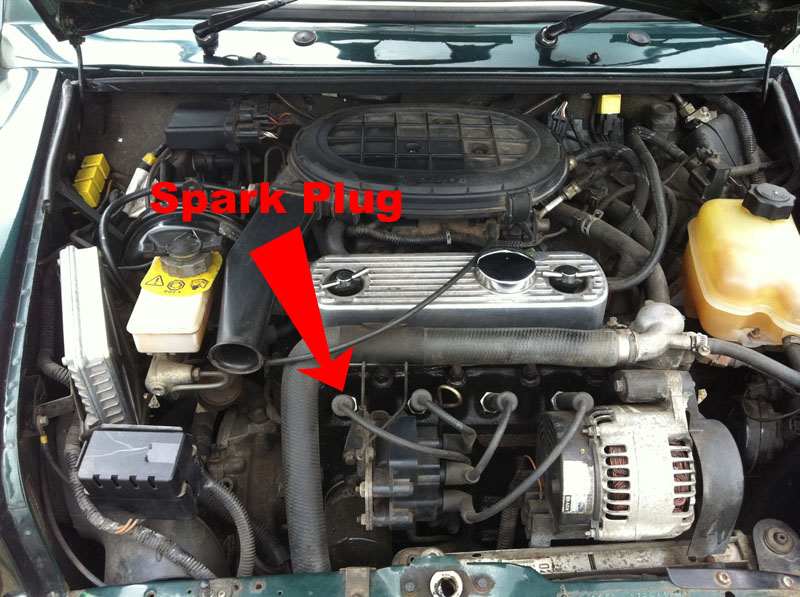
4. Bad Spark Plugs
A car engine won’t start with bad spark plugs because they do not supply any electric spark for the combustion to happen. One symptom of bad spark plugs is when you start the car, the engine cranks and turn over for a short while then stall. Another symptom of a bad spark plug is the engine starts but shakes regularly then stall right away. What you can do is pop the car hood, look for four or six thick wires (plug cables) which located in a row (see labeled diagram of car engine for a clearer picture). The end of these wires are spark plugs. Open up the spark plugs and check if there are black dirty burn marks covering all over the plugs. These black dirty burn marks are carbon deposits. Any damage to the electrode on the plug or worn out surface indicates the signs of a bad spark plug. It is time to change all of them! A car hesitates when accelerating is also another symptom of bad spark plug.
5. Ignition Coil and Distributor
Spark Plugs are new but the car still does not start. If you are starting an old car engine that come with an ignition coil and a distributor, you will need to trace where the electric “lost”. First, unplug one of the spark plug cables and touch it gently to any body part that is connected to the negative power. Get a helper to help you start the car. Observe it carefully if there is a spark at the end of the plug cable (the connector). If there is a spark, it means the coil and distributor are both working. You will need to check the ignition coil and distributor if there is no spark.
Check the ignition coil. Get an auto circuit tester (test pen) and test both the positive and negative connector. Both should have lights which indicate the electric supply is available. One should be brighter and the other should be dimmer. There is a plug cable (plug wire) connect to the distributor from the coil. Unplug the cable end from the distributor and touch it tenderly to any car parts with negative power. Have someone to start the car and monitor if there is a spark. No spark indicates a malfunction coil and if there is a spark, it is mostly the distributor that is giving problem.
Engine cranks but car won’t start is usually the symptoms of electrical problems including spark plugs, ignition, ignition coil, or distributor.
6. Secure Lock
For certain cars, you are not able to switch on the ignition with the steering locked. Turn the steering wheel a little bit to left and to right and you will be able to turn on the ignition. Check also if the gear is position at P (Parking). Some cars are not able to start if the gear is not position at P. See also: Learning to drive an automatic car.
Above are the six basic ways to diagnose a car engine problem. It can be done easily for someone who does not really understand about car. You should consult a mechanic if the matter is more serious than you can imagine. Last but not least, it is highly recommended to check your car engine regularly in order to protect your car investment.
