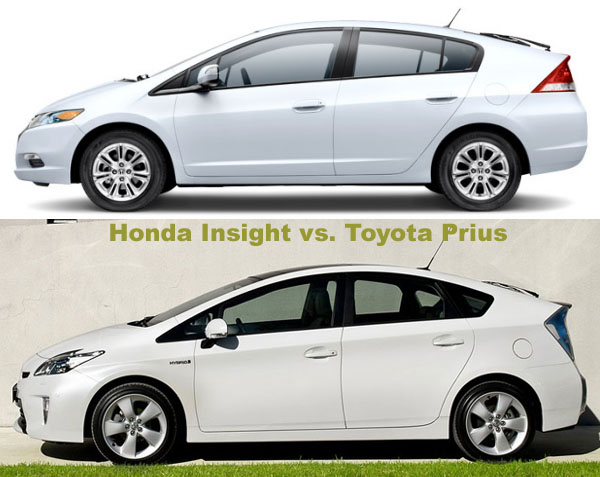
Ladies and Gentlemen, the battle of Honda Insight vs. Toyota Prius is now begins! On the top, both of these cars have a lot look-a-like but under the hood, they have plenty of differences. The Toyota Prius has dominated to the hybrid car market since 1997. It was first launched in Japan in 1997 and went on sales worldwide since 2001. On the other hand, the Honda Insight is a new comer to hybrid market since 2010. Both of them are currently the most interesting and hottest mid-size hybrid cars available in the market and it will be fun to compare them from head to toe.
Round 1: The Design
Cargo room: Compare the Toyota Prius and Honda Insight side by side, the Prius has more room for the front seats, back seats, and boot. One of our drivers is 170cm (5’6’) and he is complaining the head room isn’t enough for him when he sits on the driver seat. As for the back seat, Prius tends to have more legroom compared to Insight. When we checked out the back seat of the Insight, we found the low roof line makes the access a little bit tricky. Passengers need to stoop a little bit in order to get into the car to avoid hitting the roof.
Trunk: At 21.6 cubic feet, the Prius’ trunk is slightly bigger compared to the Insight which has a much smaller backside of 15.9 cubic feet.
Round 2: Fuel Economy, Performance, and Safety
Fuel Economy: While the Insight is smaller, it is suppose to be more fuel efficient. It did get 41 city/44 highway mpg but the Prius perform better at 51 city/48 highway mpg.
Engine: The heart of the Insight consists of a 1.3-liter four-cylinder gasoline engine paired with an electric motor. The combination produces a maximum output of 98 hp and 123 lb-ft of torque. While we take the car up hill with four passengers inside the Insight, the car suffers a little bit at sloppy hill. The Prius is powered by a bigger engine – a 1.8-liter four-cylinder engine married to a pair of electric motors. The combine power sends a total output of 134 hp.
Curb Weight: Honda Insight is 1,237 kg (2,730 lb) and Toyota Prius is 1,380 kg (3,042 lb)
0-60 mph: The Honda Insight accelerates from 0-60 mph in 10.9 seconds while the Prius did the same in 10.1 seconds. A few tenths slower than the Toyota Prius.
Round 3: Safety
Honda Insight: Front airbags, Side airbags, Head airbags, 4-wheel Antilock Brakes System, Electronic Brake Enhancements, Traction Control (Not available on LX model), Stability Control (Not available on LX model), Tire-pressure monitoring system.
Toyota Prius: Front airbags, Side airbags, Head airbags, Knee airbags for driver, 4-wheel Antilock Brakes, Traction Control (Standard), Stability Control (Standard), Tire-pressure monitoring system.
Round 4: Interior
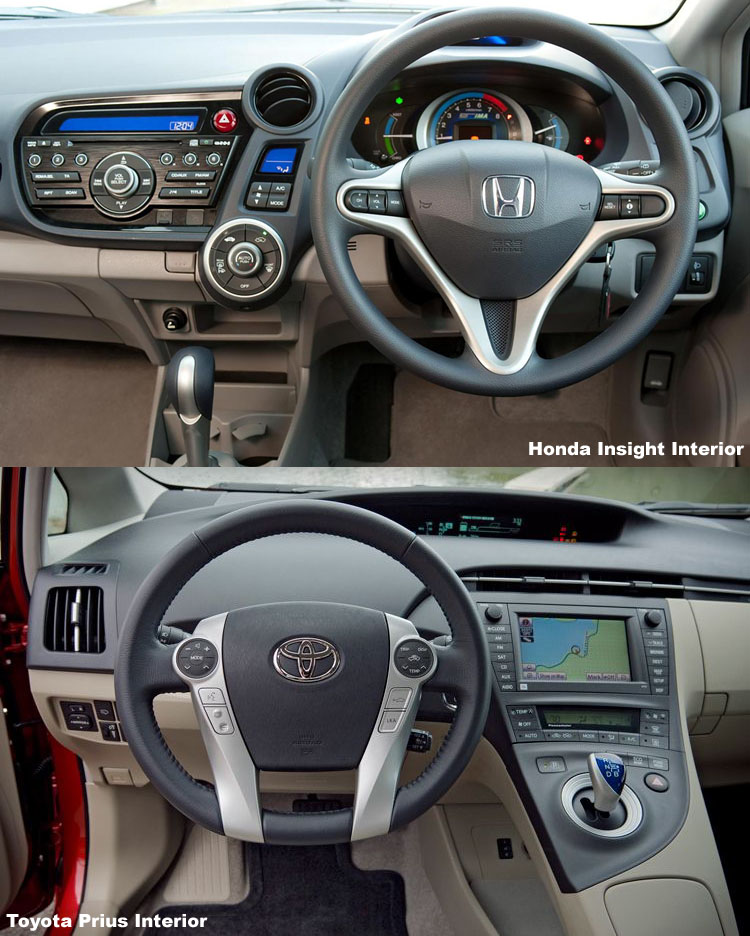
The interior of the Prius features a multifunction display which the graphics look like the video games from the ‘80s. When the driver use the steering wheel control, there will be a display appear in the dashboard. Overall, the driving experience is very good and the car is very quite but not until the driver step hard on the gas pedal.
The interior of the Insight is quite simple and straight-forward compared to the Prius. It features a standard automatic climate control, visual aids, and a speedometer with changeable background color.
Round 5: Price
- Honda Insight: MSRP from $18,500 to $21,965
- Toyota Prius: MSRP from $24,000 to $29,805
Round 6: Fun Or Not?
The turning circle diameter is one of the factors to determine whether a car is fun to drive or not. Honda Insight is featured with an electric power steering with a turning cicle of 34 ft. On the other hand, the Toyota Prius has 34.2 ft turning circle diameter for Prius Two, Prius Three, Prius Four, and 36.0 ft turning circle diameter for the Prius Five. The Insight is slightly tighter than the Prius but both of the cars are fun to drive and it kills every corner on the road.
Round 7: What else except Honda Insight and Toyota Prius?
Other than Honda Insight and Toyota Prius, there are some other hybrid cars in the market that constantly received good reviews from automobile enthusiasts. These cars are Ford Fusion hybrid, Honda Civic hybrid, Lexus CT200h, Toyota Camry hybrid, Toyota Prius C, Honda Jazz hybrid and some other vehicles in the Hybrid car list.
Conclusion
The Toyota Prius is without doubt a recognized good hybrid car in the market with over millions of units sold. However, consider the economy we are in today, buyers who feel the price of a Prius is high may consider the Insight as an alternative which is nearly as good as the Prius. As for the look, one man’s meat is another man’s poison, we will leave this to the buyers.