Tag: how to

  • Learning to drive a manual car

    Most people find learning to drive a manual car is much harder than an automatic car especially when they need to do a parallel park or drive uphill. Students often fail in these two skills in the driving test. There is a necessity to master these skills not only for the test but also to drive better in your life. Here is the step by step on how to drive a manual car and tips to handle all kind of circumstances in a manual car.

    Understand a manual transmission car
    Manual car

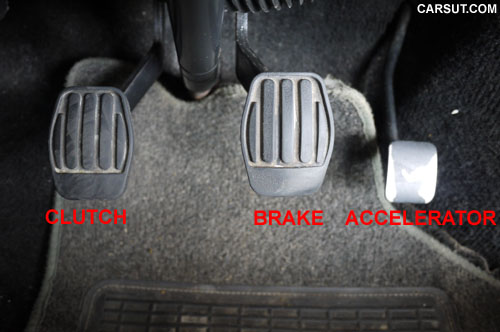
    A manual transmission car has three pedals: on the right is the gas pedal/accelerator, on the left is the clutch pedal, and in the middle is the brake pedal. A clutch is a doorway to shift the gear. No gear can be shifted if the clutch is not applied. Whether it is LHD (Left-Hand-Drive) or RHD (Right-Hand-Drive), you will see these three pedals. For LHD car, you will use your right hand to shift the gear and the other way round for RHD car.

    Study the Stick Shift
    Stick Shift

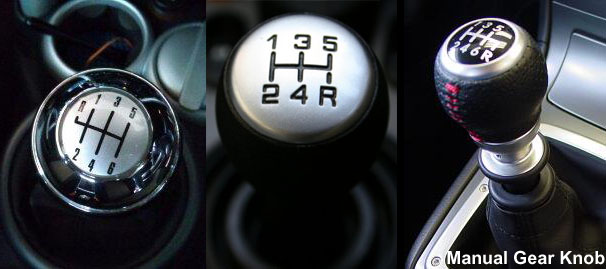
    Most of the manual cars running on the road today are five-speed. Some manual cars like the Honda CR-Z have six-speed while some earlier type has only four-speed. Before driving the car, sit on the driver’s seat, use your left foot to press the clutch to the floor and try to shift every gear to familiarise with it. The numbers indicate the gear and the “R” means reverse gear. Check if your gear knob has a button that locks the reverse gear. Some cars like the Renault Kangoo comes with a lock where you need to press/pull a button to shift the gear into reverse. Once you are familiar with the shifting, make sure you shift it back to neutral (in the middle where you don’t feel the stiffness in the gear stick) before starting the car.

    stick shift pattern

    Step by step to drive a manual car

    Step 1: Adjust the driver’s seat to a position where you can fully step down the clutch pedal with your left foot. Your body will move back a little bit when you drive up hill. Therefore, do not slight the seat too far or too close from the pedals.
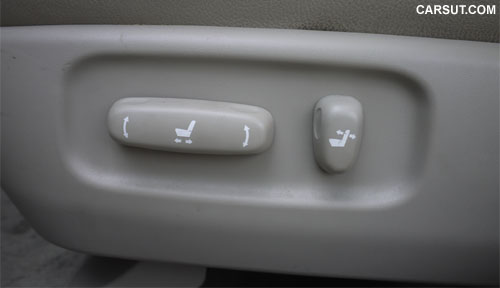
    automatic seat adjuster

    Step 2: Make sure the gear is shifted to neutral and the handbrake (e-brake) is engaged. Use your right foot to step on the brake and start the car. For better practice, you may also press the clutch with your left foot every time you start the car to avoid the car going forward if the gear is engaged without your knowing.
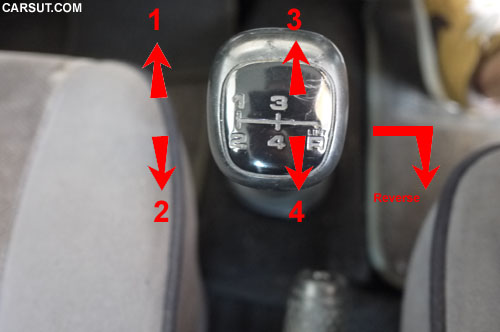
    manual transmission car

    Step 3: Press the clutch all the way down to the floor and shift the gear to first (1) gear. Look around to see if there are any vehicles coming. If it is safe to take off, release the handbrake.

    Step on the clutch

    Step 4: Release the clutch gently and step on the gas pedal lightly simultaneously. Give more gas to the car or hold the clutch if the engine sounds like it is going to stall. Move your left foot to the foot rest area when the car moves forward.
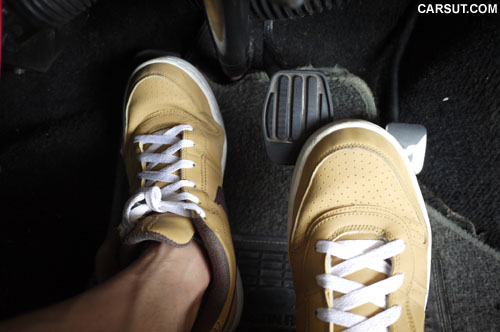
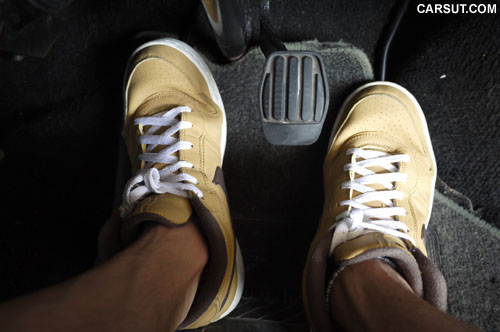
    drive a manual car step four

    drive manual transmission car step 5
    Step more on the gas pedal/accelerator to go faster

    Step 5: Change gear. An experienced driver knows when to change the gear by listening to the engine sound. A good way for beginners is to look at the RPM gauge. Shift the gear when it reaches about 3000 to 4000 rpm. To shift to second gear, lift the right foot from the gas pedal, press the clutch pedal all the way down and shift to second gear. Release the clutch gently and step on the gas pedal as in Step 4. The more you step on the gas pedal, the faster the car goes. Repeat the same process to shift to other gears.
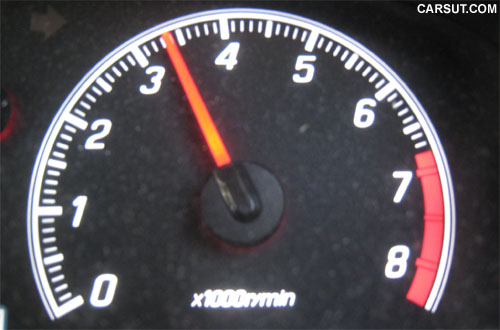
    3000 rpm

    Step 6: Slow down and stop. Lift your right foot from the gas pedal, use the left foot to press the clutch, and then apply the brake to slow down the car or to stop the car. Once the car is stop, shift the gear to N (Neutral) and apply the handbrake.
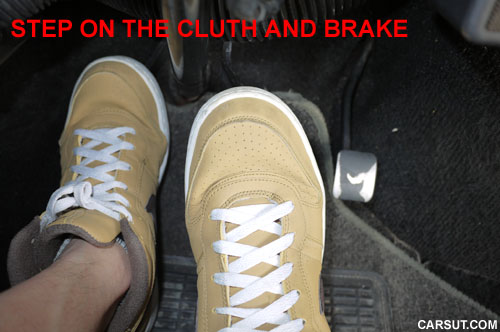
    drive manual transmission car step 6

    Tips

    Seating Position. Many people fail in the driving test during uphill because their left foot could not fully reach the clutch pedal. This is because the seat is too far from the pedals. Adjust it to a position where you are able to press the clutch all the way down the floor even your body is close to the seat.

    Clutch Control: First gear is always the hardest. Control the clutch gently every time you release it. Gently here means slowly, gradually, or bit by bit. Many first time learners lift their left foot immediately and cause the car engine to stall. Step hard on the brake and the clutch, and pull the handbrake to stop the car in case of emergency.

    Reverse: Many people make mistakes by shifting the gear to reverse while the car is still moving forward. Wait until the car stopped completely and then only shift to reverse gear.

    Stop at traffic: Shift the gear to neutral and apply the handbrake every time you stop at traffic. This is to secure the car from being jerk forward if you are hit from behind.

    Going uphill: If you are going uphill and need to stop the car on the slope, shift to neutral and apply the handbrake. To continue the journey, step on the clutch, shift to first gear, and give more gas (step harder on the accelerator) with your right foot. Release the handbrake when you feel it is powerful enough to move forward. More gas (But not too much) is needed because the car is in a sloping position.

    Going downhill: Shift to lower gear for downhill driving to increase the engine braking effect.

    Most drivers experienced engine stall while they learn how to drive a manual car. Practice makes perfect. The more you practise, the better your driving skill will be.

  • How To Parallel Park A Car

    Parallel parking is always a coup de grace for drivers who are taking their test. It is not hard at all to parallel park a car as long as you have caught the skills during the training. For beginners who have just started to learn parallel parking, it is recommended to learn it at a quiet place or places with the least traffic possible. This is to avoid distraction and also to reduce the driver’s stress. Learn how to parallel park here with six easy steps.

    Step 1: Approaching a parking lot
    Parallel park step 1

    When you are approaching a parking lot or a space, check the rear view mirror, side mirror, and blind spots. Make sure there is no vehicles following you too close. Give signal towards the parking lot as you approach it.

    Step 2: Measure the space
    Parallel park step 2

    You will need to make sure the space is adequate for your car as you approach it. Slow down the car beside the parking lot and see if there is an adequate amount of space for your car. A parking lot that has at least four to six feet longer than your car is recommended for beginners. Look for a bigger parking lot if you feel the space is too small or uncomfortable to park the car.
    Measure the parking space

    Step 3: Line up your car
    Parallel park step 3
    With the signal light on, parallel your car next to the parked vehicle in front of your desired parking lot. Keep a distance of two feet from the parked vehicle. If the parking lot is tight, you may need to keep a distance of less than two feet. Do not get too close to it otherwise you may hit it when you’re maneuvering your car. The easiest way to parallel your car with the parked vehicle is either align your rear bumper with the vehicle’s rear bumper or align your rear wheel next to the parked vehicle’s rear wheel.
    Parallel the car
    Click on the image to enlarge it
    Parallel parking

    Step 4: Reverse
    Parallel park
    Double check all the mirrors to make sure there is nothing behind you but a space to park the car. Imagine you are going to maneuver your car in an S-shape. Put your car in reverse gear and turn the steering wheel hard towards the curb to execute the first part of the “S”. Reverse it slowly and do not step too hard on the accelerator. Go slow and steady.

    Step 5: Last part of S-turn

    Turn the steering wheel hard to the other side (opposing the curb) and pull in once:

    A: Your front seat is in line with the parked vehicle’s rear bumper.
    step 5

    or

    B: Your left rear corner is in line with the left front corner of the vehicle behind (if you are parallel parking to your right) or your right rear corner is in line with the right front corner of the vehicle behind (if you are parallel parking to your left)
    step 5 second choice

    or

    C: You see the front corner of the parked vehicle behind you from your side mirror.

    If your rear tire or rear bumper hit the curb, it means you turn the steering wheel at the wrong timing or you did not turn the steering wheel hard enough. Use your mirrors to check the car position and also check around to make sure it is clear. Continue reversing the car until it is fully parked into the space. Make sure you do not hit the bumper of the car behind you.
    bad parallel park
    Example of bad parallel park

    Step 6: Align the car

    Parallel park step 6

    Turn the steering wheel to the center once you have parked into the space. If your rear bumper is too close to the front bumper of the car behind, pull your car forward a little bit to the center of the parking lot. Do not cross the parking lot lines. Compare your right front bumper with the right rear bumper of the vehicle in front. If they are parallel, you have successfully parallel parked your car. Sometimes, both of the parked vehicles (front and back) could be in a bad position. Check if your car stays around 6 to 12 inches away from the curb. You may not be able to open your car door if it is too close as the door may hit the curb. You may risk having someone kill your side mirror if you park the car too far from the curb.
    Parallel park

    Tips for parallel parking:

    • You will need to see the type of the vehicle parked in front of your desired parking space when you line up your car. If it is a vehicle with super long trunk like the classic Chevrolet Impala, it will be better to align your car with the bumper.
    • If there are any vehicles coming from behind when you’re approaching a parking space, give signal to the driver and let them pass if necessary.
    • Never use the front to go in first.
    • When you are approaching a space, check and see if any of the cars at the front and at the back is leaving or any drivers is sitting inside the car. If there is, let them leave first.
    • You can always move your car back into the starting position if things are not according to what you have planned.
    • Use student driver magnets or L (Learning) license plate to notify other drivers while you are learning how to parallel park a car.
    • If your car is parked too far away from the curb once you completed all the steps, it could mean you pull your car too far from the parked vehicle when you parallel your car with it in Step 1.

    Key to remember

    1. Measure the space
    2. Parallel your car with the parked vehicle
    3. Turn the steering wheel away from curb when front seat (the rear of the front door) is IN LINE with parked vehicle’s rear bumper.

    Click here to see the video of how to parallel park.

  • Learning To Drive An Automatic Car

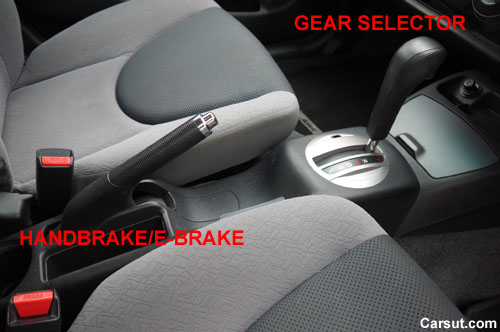
    Learning to drive an automatic car will be faster and easier compared to manual transmission car. This is because the driver is not required to shift the gears manually. The car will go forward when the “D” (Drive mode) is engaged and it will reverse when the “R” mode is engaged. No clutch control is needed and you do not have to shift the gear manually. It is easier because you will only have to remember the gear knob, handbrake (e-brake), pedals, and steering wheel.

    Understand an automatic transmission car

    automatic pedals

    Once you are on the driving wheel, adjust the seat to a position where it fits you the best. There are only two pedals all the way down from the steering wheel. On the right is the gas pedal (petrol pedal) and on the left is brake pedal. If you are driving a RHD (Right-Hand-Drive) car, the gear knob and handbrake will be on your left and you need to use the left hand to control it. If you are driving a LHD (Left-Hand-Drive) car, the gear knob and handbrake will be on your right and use the right hand to manipulate it. Adjust the rear view mirror and two side mirrors so that you can clearly see if there is any vehicles coming from the back or both sides.

    Automatic car

    Study the gear selector

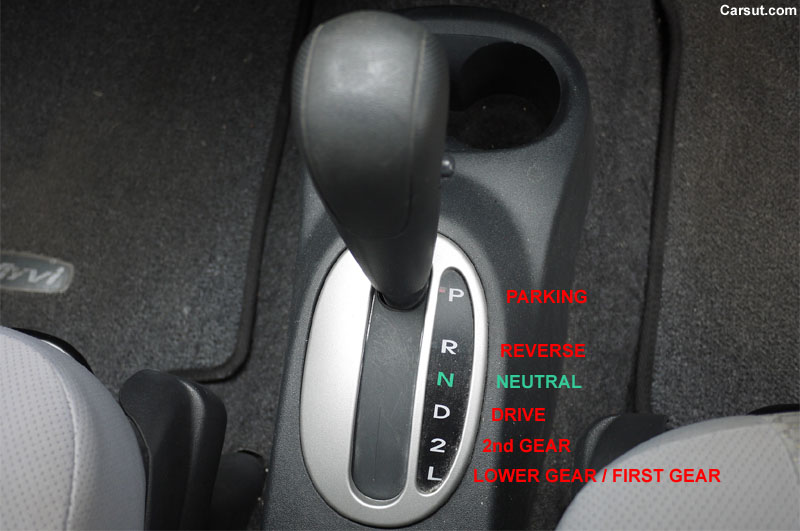
    A standard automatic gear selector has the basic four markings:

    P: Parking. Select P when you park your car.

    R: Reverse. Select R when you want to reverse the car.

    N: Neutral. Select N when you want to push the car or tow it.

    D: Drive. Select D to drive the car.

    Some cars will have extra markings other than the basic four above. It depends on how many speeds the automatic transmission has. Some cars like Honda or Toyota are equipped with five-speed automatic transmission. It is to allow the driver to have a better control to the car and sometimes it is useful to achieve slightly better mileage when driving in cities with heavy traffic jams. These are other automatic gear patterns found in some cars.

    Honda Civic Honda Fit Mini Cooper Others Others
    P
    R
    N
    D
    D3
    2
    1
    P
    R
    N
    D
    S
    L
    P
    R
    N
    D
    P
    R
    N
    D
    S
    P
    R
    N
    D
    L

    Automatic gear selector
    Some automatic gear patterns

    D3 or 3: This mode restricts the transmission to the first three gears, which means no matter how hard you throttle the gas pedal; the transmission will not change to fourth gear.

    D2 or 2 or S (Slow): Shifting into this mode means the transmission will be locked in second gear. The car will start to run in first gear but only limits up to the second gear. It is very useful for driving up hill or driving in adverse conditions. It is also useful to increase the engine braking effect during downhill driving.

    D1 or 1 or L (Low): Shifting into D1 or L indicates that the car will only run in first gear. This mode should only be engaged for towing, uphill, or downhill, otherwise the engine will be damaged if the RPM is too high.

    Overdrive or OD or ‘O/D OFF’: This mode is only available in some cars. It can be found as a small button attached to the gear knob or located somewhere around it. The car will shift to lower gear when you turn it on. Use it when you want to over take or in circumstances that require a lower gear.

    Step by step to drive an automatic car

    Step 1: Make sure the handbrake is engaged and the gear knob is positioned at P (Parking). Some cars cannot be started if the gear is not in the P mode. Step on the brake pedal with your right foot and turn on the ignition to start the engine. There are some automatic cars that can only be started if the brake is applied.

    Automatic transmission

    Step 2: Press your right foot on the brake pedal and make sure the brake is still on. Shift the gear selector to D mode. Check if your gear knob has a button that locks the transmission. If there is, you will need to press it to shift the gear selector. You may feel the car jerking slightly on an old car.


    Shift the gear selector to “D” (Drive).

    Step 3: Look around to see if it is safe to take off. Then release the handbrake and lift your foot slowly off the brake pedal.

    handbrake

    Step 4: Shift your right foot to the gas pedal. The more you step on the gas pedal, the faster the car will go.

    Step 5: Slow down the car. To slow down the car, move your right foot from the gas pedal to the brake pedal. Step down the brake pedal gently and the car will stop.
    Step on brake pedal

    Step 6: Making turns. When it comes to junctions, slow down the car and stop the car before the stop line if it is necessary. Turn the steering wheel towards the desired direction and step on the gas pedal gently.

    Step 7: Stop at traffic. From time to time, you will have to stop the car at traffic. If the traffic is crawling (stop for a few seconds and then move for a few seconds), step on the brake pedal to temporarily stop the car and then engage the gear to N. If the traffic is heavy or the traffic lights just turn red (you are required to wait for a long time), select N and apply the handbrake firmly. This is to secure the car from being shoved if you are hit by any vehicles.

    Step 8: Emergency brake. You should step on the brake pedal as hard as you can during emergencies. During the millisecond moments, make sure there is no vehicle trailing too close from behind.

    Step 9: Reverse. The steps to reverse a car are similar to those of running the car in first gear. With the brake on, engage the R (Reverse) gear. Release the handbrake and lift your foot from the brake pedal gently. The car will go reverse slowly and step harder on the accelerator if you want to go faster.

    Reverse gear

    Tips:

    • Never EVER use both feet to drive an automatic car. It is incorrect to use the right foot for gas pedal and the left foot for brake. Use only the right foot to operate both pedals.
    • Never use the handbrake to stop the car. The correct way to stop the car is to step on the brake pedal.

    Click here to see the video of How To Drive An Automatic Car.

  • Build a rubber band powered car

    rubber band powered car

    There are many ways to build a rubber band powered car. But it requires some skills to build one that really goes very fast and very far. Here you can find the step by step on how to build a rubber band car that can go fast. It takes only a few minutes by using some recycle things in your home. (more…)