Tag: automatic

  • How to Change Gears in an Automatic Car

    Although an automatic car handles almost everything related to the gears, there are times when you need to change gears manually even in an automatic transmission. These circumstances are such as when you need to overtake a car at a speed very close to you or when you need extra power to go uphill. Compared to manual transmission cars, an automatic car is much more popular because it shifts gears robotically for the driver. Many new drivers who are learning to drive a car prefer to buy automatic cars over manual cars because it’s easier to drive uphill without rolling back. In addition, it’s easier to drive because you don’t have to worry about the gearbox.

    Automatic Car Gear Pattern

    In the late 80s and 90s, almost all states in the U.S. requires everyone to learn to drive a manual car before they are able to get a valid driving licensed. In recent years, people in certain states are able to get a valid driving license as long as they know how to drive an automatic car. This happens not just in the U.S. but also some other countries such as Canada, Japan, Mexico, South America, China, Germany, United Kingdom, Singapore and others. However, it’s vital to know the difference between automatic and manual cars even if you don’t plan to drive a stick shift forever.

    change gear automatic car transmissions
    Gear selector on different automatic cars

    A standard automatic gear selector is usually come with four basic markings, they are P  for Parking, R for Reverse, N for Neutral, and D for Drive. Some automatic cars come with a small overdrive button located on the gear selector. For luxury automatic cars, it usually comes with extra markings other than the basic four mentioned. Normally you will see D3 (third gear), 2 (2nd gear), S (Second gear), 1 (first gear), L (Low gear) or other similar markings. You can change gears in an automatic transmission as long as you understand all meanings on the marking. Also, you can even make an automatic car tires spin once you have captured the idea.

    Three Ways to Change Gears in An Automatic Car

    There are three easy ways to shift gears in an automatic car. The first method applies to all automatic cars while second only applicable to a car that comes with overdrive features. The last method works on automatic cars with extra markings on the gear selector, for example, D3, D2, 1, D, and + or – signs.

    Method 1: Step on the gas pedal

    Step on the gas pedal as hard as you can to downshift for more power if you are going uphill or overtaking another car. Many new cars are designed to downshift for more power when a driver step on the gas pedal all the way to the floor. You will feel your car accelerates quickly once the gear is changed. On the other hand, you can also downshift a car by easing off the gas pedal. To upshift, simply give more gas to your vehicle.

    Method 2: Use the Overdrive

    The overdrive method is one of the easiest way to downshift an automatic cars. Activate the overdrive feature to downshift when you are driving at sustained speed. The car will give you more power with higher Revolutions Per Minute (RPM) to overtake any vehicle in front.

    overdrive automatic cars

    Method 3: Use the Extra Markings

    Using the extra markings on your gear selector is one of the best way to change gears in an automatic car. First of all, you will need to study the number of gears you have in your car. There are 7 speed, 6 speed, 5 speed as well as 4 speed automatic transmission. Normally your gear selector will be at D (Drive) while cruising at a constant speed. To downshift, simply shift the gear selector to one speed lower than D, normally it will be S, D3, 2 or L. This is very helpful when you are going uphill or need extra power. Remember to shift the gear selector back to D otherwise your car will be maintained at low gear.

    Last but not least, check out our step-by-step driving guide: How to parallel park a car, How to turn on car headlights, How to do a burnout. Alternatively, you can also read our complete car buying guide that you won’t find it elsewhere.

  • Difference Between Automatic and Manual Cars

    It’s not embellish to say that many people don’t really know the exact difference between automatic and manual cars. Take an example of the answer we get from a random drive who have been driving an automatic cars with a valid driving license for 3 years, “You don’t have to worry much about driving an automatic car. I usually put the gear selector to D and just drive it. For manual cars, it is quite troublesome because you have to deal with the clutch and shift gears all the time.” She definitely made her point but there are few more things about both automatic and manual cars you need to know.

    8 Differences Between Automatic and Manual Cars

    Learn the difference between automatic and manual cars will allow you to drive better. It will also give you adequate knowledge to make the correct decision when buying a new car. Basically, there are five main differences between manual and automatic transmission cars.

    1. A manual transmission car has three pedals – clutch, brake and accelerator (gas pedal). An automatic transmission car has only two pedals – brake and accelerator.

    difference between automatic and manual cars

    2. A manual transmission car features a gear shift. It is also known as Stick Shift. You need to press the clutch in order to shift gears. An automatic transmission car features a gear selector where you need to put the car to D to drive it. The gear selector in an automatic car also has P (Parking), R (Reverse) and N (Neutral).

    automatic and manual transmission cars

    3. It is more complex to get started on a hill when driving a manual car compare to automatic car. In a manual car, the driver needs to control the clutch and shift gears manually. See learning to drive a manual car for more details. In an automatic car, the driver only needs to put the gear selector to D and drive it because the car will shift automatically for you.

    4. You need to press the clutch and apply the brake to slow down or stop a manual car. As for automatic car, all you need to do is lift your right foot from the gas pedal to the brake to slow down or stop the car. Some people prefer automatic car because it is easier for parallel parking.

    5. When it comes to pricing, all the manual transmission cars tend to be less expensive compared to automatic transmission cars because the transmission system is simpler. An automatic transmission consists of complicated technology thus is it more expensive to repair. You could save up few hundred dollars if you are buying a stick shift.

    6. It is easier to do a burnout in manual car compared to automatic car because you can control the wheel spin with clutch. See how to do a burnout for more details.

    7. Automatic cars bring more advantages when you are driving in traffic jam because you don’t have to keep shifting gears like the manual cars. Driving a manual transmission car in traffic is simply gruelling.

    8. Manual transmission cars typically gives a better gas mileage. This is because the driver can control the car based on the road conditions. Also, you can rev your engine to the redline in a manual car but you can’t do it in automatic cars. Redline is the maximum RPM value a car engine is able to handle.

    Most cars on the road today are automatic transmission because they are easier to drive especially for people who are learning to drive a car. In conclusions, there are advantages and disadvantages of both manual and automatic cars. All you need to do is understand the difference between automatic and manual cars and go for the one that suits your needs the best.

  • Google self-driving car hit Nevada’s Street

    Google Car

    We have heard of Google robotic car that will drive itself years back and now it is no longer just a dream. Yesterday, Google self-driving car officially licensed in Nevada and it takes a blind man for spin. This blind man is legally pleased in the front passenger seat and he just let the Google car handles everything.

    The Google car is a Prius with 100,000 miles on it. It is equipped with GPS, radar, radio sensors, Artificial Intelligence software, and video cameras to actually “see” the traffic as well as pedestrians. The rest of the vehicle parts are nothing special but just an ordinary Prius. It is driving all by itself at Nevada’s curviest road without hitting anything. The first blind man who sat in the Google self-driving car is 95% blind and he is far beyond legally blind. The Google car knows where to stop and where to turn base on Google maps and Google on-the-road images. There are no hands, no feet, and it is totally nothing. We are pretty sure this blind man had a great time in Google Car.

    The license to this driverless car requires at least two humans to be in the car at all times, with one typically in the front seat ready to take over the control in case of emergencies. Earlier in spring, Google mentioned “safely completed over 200,000 miles of computer-led driving.” However, safety issues are still consumers’ biggest concern.

    Google robotic car

    Car manufacturers spent millions of dollars to develop a new car and have them to crash into walls to test the safety just to produce a reliable and safety car. Although the Google car does not have to crash into walls, it has costs billions of efforts to develop a robotic car or self-driving car like that. At least up till this stage Google has marked a new milestone for the automatic car project and this has allowed us to imagine the future roads with unlimited automatic cars. Well, there will be no more drivers flirting then.

    The license for autonomous vehicle features new red plate and an infinity symbol and AU letters. These “test vehicles” could be on demonstrations again anytime on the road in Nevada. So Nevadians, stay tuned!

  • How To Drive An Automatic Car (Video)

    [cvg-video videoId=’4′ width=’500′ height=’333′ mode=’playlist’ /]

    This is a short video to show you how to drive an automatic car in few easy steps. It was taken in HD mode and it can be enlarged. Follow these steps and you can learn to drive a car easily.

    Step 1: Make sure the handbrake or e-brake is engaged and the gear knob is positioned at P (Parking).

    Step 2: Step on the brake pedal with your right foot and turn on the ignition to start the car.

    Step 3: Shift the gear selector to D (Drive) mode and release the handbrak/e-brake.

    Step 4: Shift your right foot to the accelerator or gas pedal and step on it slowly. The more gas you put in, the faster the car will go.

    Click here “Learning To Drive An Automatic Car” for more details with images.

  • Learning To Drive An Automatic Car

    Learning to drive an automatic car will be faster and easier compared to manual transmission car. This is because the driver is not required to shift the gears manually. The car will go forward when the “D” (Drive mode) is engaged and it will reverse when the “R” mode is engaged. No clutch control is needed and you do not have to shift the gear manually. It is easier because you will only have to remember the gear knob, handbrake (e-brake), pedals, and steering wheel.

    Understand an automatic transmission car

    automatic pedals

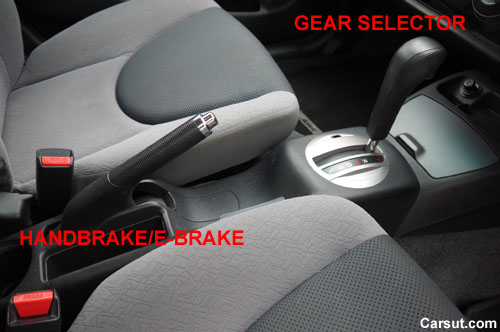
    Once you are on the driving wheel, adjust the seat to a position where it fits you the best. There are only two pedals all the way down from the steering wheel. On the right is the gas pedal (petrol pedal) and on the left is brake pedal. If you are driving a RHD (Right-Hand-Drive) car, the gear knob and handbrake will be on your left and you need to use the left hand to control it. If you are driving a LHD (Left-Hand-Drive) car, the gear knob and handbrake will be on your right and use the right hand to manipulate it. Adjust the rear view mirror and two side mirrors so that you can clearly see if there is any vehicles coming from the back or both sides.

    Automatic car

    Study the gear selector

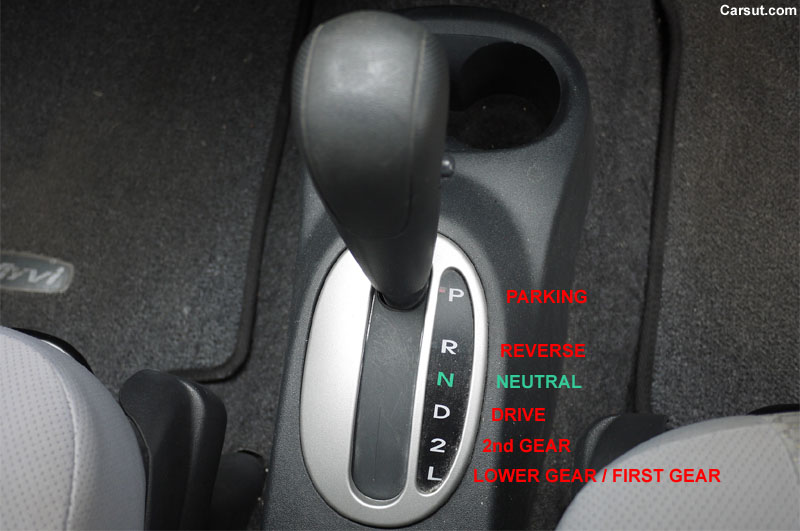
    A standard automatic gear selector has the basic four markings:

    P: Parking. Select P when you park your car.

    R: Reverse. Select R when you want to reverse the car.

    N: Neutral. Select N when you want to push the car or tow it.

    D: Drive. Select D to drive the car.

    Some cars will have extra markings other than the basic four above. It depends on how many speeds the automatic transmission has. Some cars like Honda or Toyota are equipped with five-speed automatic transmission. It is to allow the driver to have a better control to the car and sometimes it is useful to achieve slightly better mileage when driving in cities with heavy traffic jams. These are other automatic gear patterns found in some cars.

    Honda Civic Honda Fit Mini Cooper Others Others
    P
    R
    N
    D
    D3
    2
    1
    P
    R
    N
    D
    S
    L
    P
    R
    N
    D
    P
    R
    N
    D
    S
    P
    R
    N
    D
    L

    Automatic gear selector
    Some automatic gear patterns

    D3 or 3: This mode restricts the transmission to the first three gears, which means no matter how hard you throttle the gas pedal; the transmission will not change to fourth gear.

    D2 or 2 or S (Slow): Shifting into this mode means the transmission will be locked in second gear. The car will start to run in first gear but only limits up to the second gear. It is very useful for driving up hill or driving in adverse conditions. It is also useful to increase the engine braking effect during downhill driving.

    D1 or 1 or L (Low): Shifting into D1 or L indicates that the car will only run in first gear. This mode should only be engaged for towing, uphill, or downhill, otherwise the engine will be damaged if the RPM is too high.

    Overdrive or OD or ‘O/D OFF’: This mode is only available in some cars. It can be found as a small button attached to the gear knob or located somewhere around it. The car will shift to lower gear when you turn it on. Use it when you want to over take or in circumstances that require a lower gear.

    Step by step to drive an automatic car

    Step 1: Make sure the handbrake is engaged and the gear knob is positioned at P (Parking). Some cars cannot be started if the gear is not in the P mode. Step on the brake pedal with your right foot and turn on the ignition to start the engine. There are some automatic cars that can only be started if the brake is applied.

    Automatic transmission

    Step 2: Press your right foot on the brake pedal and make sure the brake is still on. Shift the gear selector to D mode. Check if your gear knob has a button that locks the transmission. If there is, you will need to press it to shift the gear selector. You may feel the car jerking slightly on an old car.


    Shift the gear selector to “D” (Drive).

    Step 3: Look around to see if it is safe to take off. Then release the handbrake and lift your foot slowly off the brake pedal.

    handbrake

    Step 4: Shift your right foot to the gas pedal. The more you step on the gas pedal, the faster the car will go.

    Step 5: Slow down the car. To slow down the car, move your right foot from the gas pedal to the brake pedal. Step down the brake pedal gently and the car will stop.
    Step on brake pedal

    Step 6: Making turns. When it comes to junctions, slow down the car and stop the car before the stop line if it is necessary. Turn the steering wheel towards the desired direction and step on the gas pedal gently.

    Step 7: Stop at traffic. From time to time, you will have to stop the car at traffic. If the traffic is crawling (stop for a few seconds and then move for a few seconds), step on the brake pedal to temporarily stop the car and then engage the gear to N. If the traffic is heavy or the traffic lights just turn red (you are required to wait for a long time), select N and apply the handbrake firmly. This is to secure the car from being shoved if you are hit by any vehicles.

    Step 8: Emergency brake. You should step on the brake pedal as hard as you can during emergencies. During the millisecond moments, make sure there is no vehicle trailing too close from behind.

    Step 9: Reverse. The steps to reverse a car are similar to those of running the car in first gear. With the brake on, engage the R (Reverse) gear. Release the handbrake and lift your foot from the brake pedal gently. The car will go reverse slowly and step harder on the accelerator if you want to go faster.

    Reverse gear

    Tips:

    • Never EVER use both feet to drive an automatic car. It is incorrect to use the right foot for gas pedal and the left foot for brake. Use only the right foot to operate both pedals.
    • Never use the handbrake to stop the car. The correct way to stop the car is to step on the brake pedal.

    Click here to see the video of How To Drive An Automatic Car.